Why Petra is worth the trip
Petra is a city carved into sandstone cliffs in southern Jordan. It was the capital of the Nabataeans, a trading people who grew rich on the caravan routes that carried incense, spices and textiles between Arabia and the Mediterranean. Rather than building upward, they cut tombs, temples and halls directly into the rock faces of a hidden valley, and they engineered channels and cisterns to keep water flowing in a dry landscape. Later the city came under Roman rule, and its importance faded as trade routes shifted. UNESCO inscribed Petra on the World Heritage List in 1985.
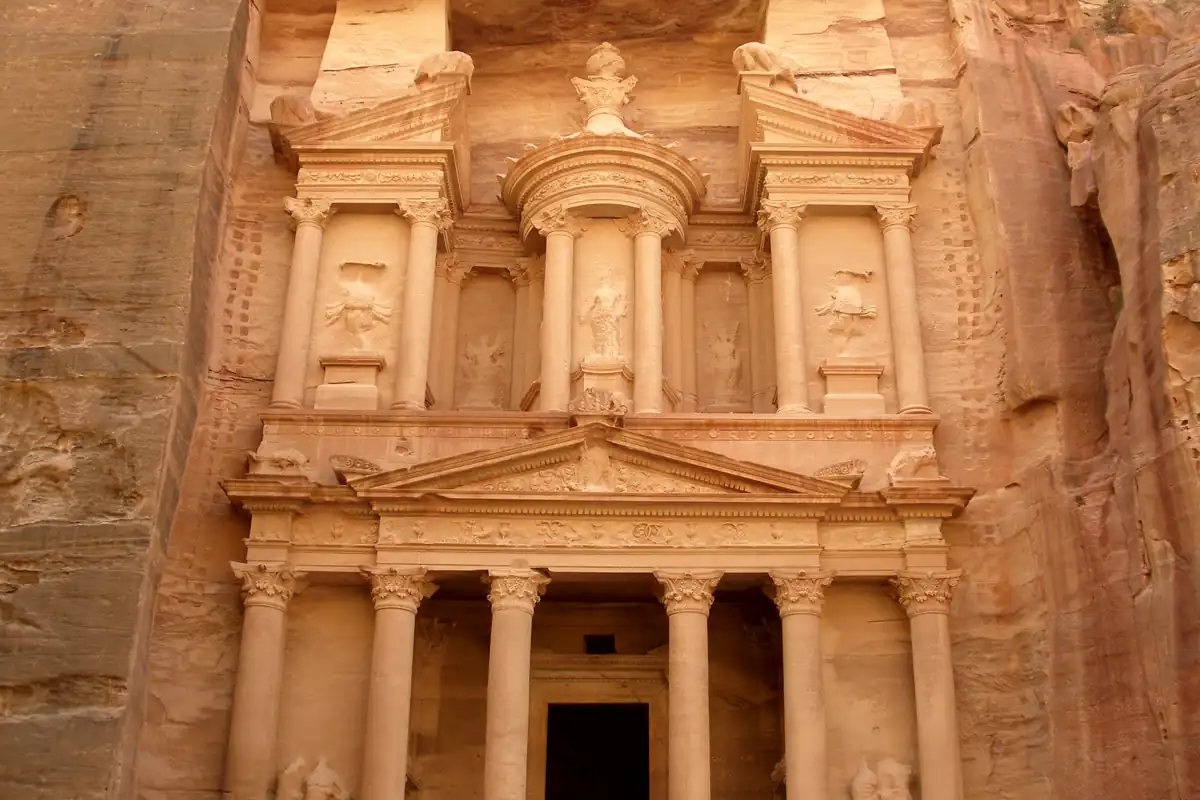
What makes a visit memorable is the sequence. You walk down a narrow gorge called the Siq, with walls rising high on both sides, and the passage suddenly opens onto the Treasury (Al-Khazneh), its columned facade glowing in the morning light. From there the valley widens into a full city of tombs, a theatre, colonnaded streets and, at the far end of a long climb, the Monastery (Ad-Deir). It is a large site, and the reward grows the further you walk.
Best time to visit Petra
Petra is an outdoor, high-walking site with long stretches in full sun, so the weather shapes your day more than anything else. For month-by-month planning across destinations, see our best time to visit guide.
- March to May: the most popular window. Days are warm, mornings are cool, and wildflowers sometimes appear on the hillsides. Expect busier trails around Easter and other holiday periods.
- June and September: workable if you start at opening time and rest through the middle of the day.
- July and August: very hot in the exposed valley. The climbs to the Monastery and the High Place of Sacrifice become tough after mid-morning.
- October and November: excellent, with softer light and comfortable walking temperatures.
- December to February: quieter and often clear, but nights in Wadi Musa are cold and rain is possible. Heavy rain can trigger flash-flood warnings and temporary closures of the Siq or side trails.
Whatever the season, arrive when the gates open. The first hour in the Siq is cooler and calmer, and the Treasury is far easier to photograph before the tour groups arrive.
Getting there
Petra lies next to the town of Wadi Musa. Most international visitors fly into Queen Alia International Airport near Amman (AMM), which is roughly three hours north by road. The Desert Highway is the faster route; the King's Highway is slower and winding but passes canyons, crusader castles and small towns, so many travellers drive one way and return the other. Aqaba's King Hussein International Airport (AQJ) on the Red Sea coast is closer, at around two hours by road.
Scheduled tourist buses connect Amman and Aqaba with Wadi Musa, and private drivers and rental cars are widely used. Driving in Jordan is straightforward on the main highways, though you should avoid long night drives on unfamiliar roads.
If you are travelling from India: there are direct and one-stop flights to Amman, and Gulf hubs offer frequent connections. Visa arrangements depend on your passport and change from time to time, so check the current rules on Jordan's official government channels before you book. Vegetarian food is easy to find in Jordan: hummus, falafel, mutabbal, foul, lentil soup and fresh salads are everyday staples.
Tickets and entry
Entry is sold at the visitor centre in Wadi Musa, with one-day and multi-day options. Many travellers who are staying several nights in Jordan use the Jordan Pass, an official scheme that bundles Petra entry with other sites; its conditions, including any visa-related benefits, should be read carefully on the official site. Check current fees, opening hours and the Petra by Night schedule on Visit Petra, as they are revised periodically.
Keep your ticket with you all day. If you buy a multi-day ticket, the days usually need to be consecutive.
How long to spend, with a sample plan
A single full day lets you see the highlights. Two days let you slow down, walk a back trail and see the Treasury in both morning and afternoon light. Staying overnight in Wadi Musa is strongly recommended; arriving on a day trip from Amman leaves too little time on the trails.
One full day
- Enter at opening time and walk the Siq, which runs for a little over a kilometre.
- Spend time at the Treasury, then continue along the Street of Facades to the Roman-style theatre.
- Look up at the Royal Tombs on the cliff to your right, and climb up to the Urn Tomb for a view across the valley.
- Follow the Colonnaded Street to the Great Temple and Qasr al-Bint.
- After a rest, climb the stairway to the Monastery. Allow time at the top for the viewpoints beyond it.
- Walk back out before closing; the return uphill through the Siq takes longer than you expect.
Adding a second day
Take the trail to the High Place of Sacrifice, an ancient altar on a ridge above the theatre, and descend through Wadi Farasa past the Garden Tomb and Roman Soldier's Tomb. Alternatively, ask at the visitor centre about the trail to the viewpoint above the Treasury, which should only be walked on marked or officially guided routes. A short drive north of Wadi Musa, Little Petra (Siq al-Barid) is a smaller Nabataean site that makes a calm half-day add-on.
Practical tips
- Footwear: wear broken-in walking shoes with good grip. The paths mix sand, loose gravel, polished rock and uneven steps.
- Water and sun: carry more water than you think you need, a hat and sunscreen. Shade is limited, especially on the Monastery climb.
- Distances: a full day often means fifteen kilometres or more of walking. Pace yourself and plan the return leg.
- Animals: donkeys, mules, horses and camels are offered for rides. Animal welfare has been a long-running concern; if you choose to ride, use animals that look healthy and are not overloaded, and never ride on the steep stairways if the animal is struggling.
- Accessibility: the main path to the Treasury is fairly level but sandy in places. Travellers with limited mobility should ask the visitor centre about current transport options along the main route.
- Clothing: Jordan is relaxed with visitors, but covering shoulders and knees is respectful, particularly in towns. Layers help on cool mornings.
- Food: there are a few cafés and stalls inside the site, but bringing snacks keeps you flexible.
Our packing list covers sun protection, footwear and a day-pack setup for long walking days like this one.
Where to base yourself
Wadi Musa is the obvious base: the town sits right at the gate and has accommodation at every level, from simple guesthouses to large resorts, plus restaurants and shops. Staying close to the visitor centre means you can be at the entrance at opening time and return easily for a break. Some travellers stay in the hills around Taybeh for wider views, and others combine Petra with nights in desert camps in Wadi Rum, roughly a couple of hours to the south.
Respectful and responsible travel
Petra's sandstone is soft and erodes easily. Do not climb on facades, touch carved surfaces or scratch anything into the rock. Stay on established trails, take your rubbish back out, and be careful with drone use, which is restricted at heritage sites in Jordan. The local Bedouin community has a long connection to this valley, and many families still earn their living from it, so buying crafts or tea from them directly supports that community. Ask before photographing people.
Pair it with
Petra fits naturally into a wider Middle East and North Africa trip. Combine it with the ancient monuments of Egypt at the Pyramids of Giza, a short flight from Amman, or, if rock-cut and mountaintop sites appeal to you, compare it with the Inca citadel of Machu Picchu.
Official sources
Check these before you go: entry rules, opening days and fees are published here and change from time to time.
- Visit Petra (Petra Development & Tourism Region Authority)
- UNESCO World Heritage listing
- Jordan Pass (official combined entry scheme)
- Visit Jordan (Jordan Tourism Board)
Book your trip to Petra
Affiliate links. If you book through these partner links, Tripsya may earn a commission at no extra cost to you. Partners never see or shape our guides. How this works.
Or go straight to a partner:
- Hotels in Wadi MusaBooking.com ↗
- Flights to Amman (AMM)Aviasales ↗
- Tickets and tours: PetraTiqets ↗
- Car hire at Amman airportDiscoverCars ↗
- Airport transfers in JordanKiwitaxi ↗
- Jordan eSIMAiralo ↗
- Travel insurance for this tripVisitorsCoverage ↗
Hotel and flight searches open for 15 November 2026 to 17 November 2026, in the best season from this guide. Change the dates on the partner site.
Live partner search, loaded only when you choose one:
Frequently asked questions
How many days do you need in Petra?
One full day covers the Siq, the Treasury, the Street of Facades and the Monastery climb at a steady pace. Two days let you add the High Place of Sacrifice or a quieter back trail and see the site in different light.
What is the best time of year to visit Petra?
Spring (March to May) and autumn (October and November) are the most comfortable, with mild days and cool mornings. July and August are very hot in the open valley, while winter can bring cold nights and the occasional rain or flash-flood closure.
How do you get to Petra from Amman?
Petra sits beside the town of Wadi Musa, roughly three hours south of Amman by road along the Desert Highway or the slower, more scenic King's Highway. Public buses, private drivers and rental cars all make the trip.
Is the climb to the Monastery hard?
It is a long staircase of several hundred rock-cut steps with little shade. Most reasonably fit visitors manage it in under an hour if they start early, carry water and take breaks.
Can you visit Petra in the evening?
Petra by Night, a candle-lit walk through the Siq to the Treasury, runs on certain evenings each week. Schedules change, so confirm the current days on the official Visit Petra website.
Planning tools: compare months for every destination in the best time to visit planner, sketch a multi-stop route in the trip planner and build a checklist with the packing list builder.