
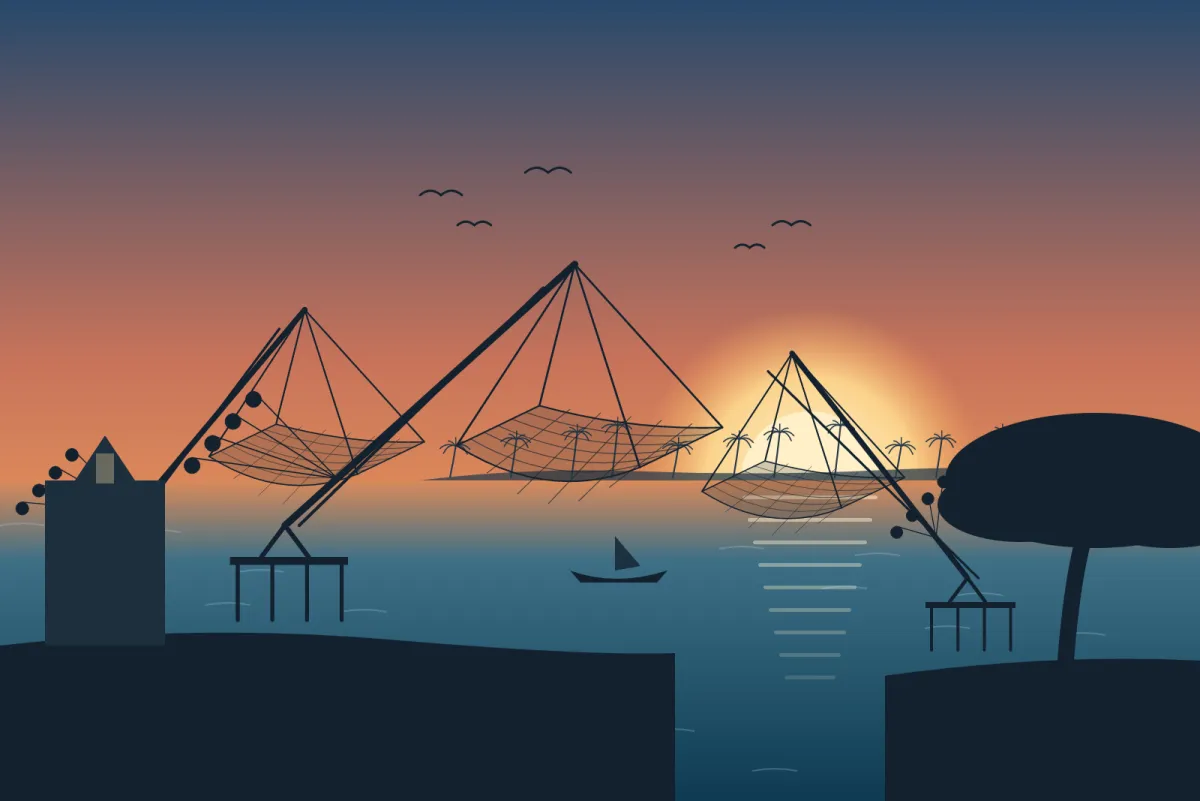
Fort Kochi in a nutshell
Fort Kochi is the old harbour quarter of Kochi (Cochin), on the western tip of the city where Kerala's backwaters meet the Arabian Sea. It is small enough to cross on foot in an afternoon, yet the layers of its history are still visible from the street: Portuguese and Dutch-era churches, a Dutch cemetery, warehouses from the spice trade, British-era bungalows around the parade ground, and the cantilevered Chinese fishing nets that have become the symbol of the city. Mattancherry, with its palace, synagogue and spice lanes, joins it to the south-east, and most visitors treat the two as one destination.
The short answer on timing: November to February is the most comfortable period, with drier weather and cooler evenings. December and January are also the busiest weeks, so sort out your room early and expect crowds around Christmas and New Year. If you do not mind rain, the monsoon months are greener, quieter and full of atmosphere.
Best time to visit Fort Kochi, season by season
| Months | What to expect | Good for |
|---|---|---|
| November–February | Drier, lower humidity, pleasant evenings; the busiest period | Walking the heritage lanes, sunsets at the nets, winter festivals |
| March–May | Hot and humid, with thunderstorms building towards late May | Early-morning walks, then museums and cafés through the afternoon heat |
| June–September | Southwest monsoon: heavy rain, rough sea, fewer visitors | Slow travel, photography and pairing the city with the backwaters |
| October | A transition month with showers from the northeast monsoon | Quiet streets just before the winter season begins |
Winter is also festival time. The Cochin Carnival fills the streets in the last days of December and ends on New Year's Eve, when a giant effigy known as the Pappanji is burned on the parade ground. In the years it is held, the Kochi-Muziris Biennale, a large contemporary art exhibition, takes over warehouses and heritage buildings across Fort Kochi and Mattancherry, usually opening in December and running into the spring. It is a biennial, so check the official Biennale site for the dates of the current edition before you plan around it.
To line Fort Kochi up with the rest of a trip, our month-by-month planner compares seasons across every Tripsya destination. Kerala's winter window also suits places further north such as the Taj Mahal, so the two combine well in one journey.
Getting to Fort Kochi
By air: Cochin International Airport (COK) at Nedumbassery, north of the city, is the gateway for domestic flights and for international routes, including many from the Gulf. Fort Kochi sits at the opposite end of the city, so allow roughly one and a half to two hours by taxi or app cab, and longer at rush hour.
By train: the main stations are Ernakulam Junction and Ernakulam Town, both on the mainland side of the harbour. From either one, take a taxi or auto-rickshaw to Fort Kochi, or go to the boat jetties and cross by water.
By water: crossing the harbour by boat is the most enjoyable way to arrive. Public ferries run between the Ernakulam main boat jetty and Fort Kochi, and the Kochi Water Metro has terminals at Fort Kochi and Mattancherry, linked to its High Court terminal in Ernakulam. Routes and timetables change, so check the current schedule before you set out. A vehicle ferry also links Fort Kochi with Vypin island across the harbour mouth.
If you are travelling from India or the Gulf: Kochi is well connected by air to other Indian cities and to the Gulf, so it works as the arrival point for a Kerala loop: Fort Kochi first, then south to Alappuzha and the backwaters. Foreign visitors should check entry rules on the official Indian e-Visa portal rather than on third-party websites.
How long to stay, and a two-day plan
One full day covers the main sights, but two days let you walk at the right times: early morning and late afternoon, when the light is soft and the heat eases. A third day is worth adding if you want an evening performance, a day trip to the backwaters, or simply time in galleries and cafés.
Day 1: Fort Kochi on foot
- Early morning: start at the Chinese fishing nets on the waterfront near Vasco da Gama Square, when crews are working the nets and the small fish market is busy.
- Mid-morning: walk to St Francis Church, one of the oldest European-built churches in India, where Vasco da Gama was first buried before his remains were taken back to Portugal. Continue to Santa Cruz Cathedral Basilica, then the Dutch Cemetery and the old bungalows around the parade ground.
- Afternoon: rest through the hottest hours, or browse the galleries and small museums along Princess Street and Burgher Street.
- Late afternoon: stroll the beach promenade and return to the nets for sunset.
Day 2: Mattancherry and the spice lanes
- Morning: visit Mattancherry Palace, also called the Dutch Palace, known for its Kerala murals of scenes from the Ramayana and its portraits of the rulers of Kochi. It is a protected monument run as a museum by the Archaeological Survey of India.
- Late morning: walk to the Paradesi Synagogue in the lanes of Jew Town. It dates from the sixteenth century and is still a place of worship, so its opening hours are limited and it closes for the Sabbath and religious holidays.
- Afternoon: wander the spice warehouses and antique lanes between Jew Town and Bazaar Road, where ginger, pepper and other spices are still traded.
- Evening: watch a short Kathakali or Kalaripayattu performance. Several small cultural centres in Fort Kochi stage them for visitors, and some let you watch the elaborate Kathakali make-up being applied beforehand.
Planning a longer route? The trip planner builds a day-by-day outline for Alappuzha and other destinations, and you can add these two Fort Kochi days at the start.
Entry, opening days and photography
Most of Fort Kochi is open streets, churches and waterfront, so there is little to arrange in advance. Entry charges and timings apply at the palace, at museums and at some heritage buildings: check the current details on the official pages or at the gate, and carry small change as well as a payment app.
- The palace and the synagogue keep their own weekly closing days and may shut for holidays, so confirm before you build a day around them.
- Photography rules differ from place to place. Some interiors do not allow cameras, and you should always ask before photographing people, fishing crews or worshippers.
- Dress modestly for churches, temples and the synagogue, with shoulders and knees covered. You may be asked to remove your shoes at some places of worship.
Practical tips for a comfortable visit
- Heat and humidity: even in winter the middle of the day is warm. Carry water, wear a hat and plan indoor stops for the early afternoon.
- Rain gear: from June to October, pack a compact umbrella, quick-dry clothes and sandals that can get wet. Our packing list builder turns that into a printable checklist.
- Getting around: Fort Kochi is best explored on foot or by bicycle, while auto-rickshaws cover the longer hop to Mattancherry. Agree on the route before you set off and decline unplanned shopping stops.
- Food: Kerala seafood is the highlight, and vegetarian travellers will find South Indian meals, appam with vegetable stew and plenty of cafés. Near the nets you may be offered fresh catch to have cooked nearby; choose places that look clean and busy.
- The beach: treat it as a promenade rather than a swimming spot, because currents can be strong and boats pass close to shore.
- Mosquitoes: use repellent around dusk, especially after rain.
Where to base yourself
Staying in Fort Kochi itself puts you within walking distance of the nets, churches and cafés, with homestays and small guesthouses in restored colonial buildings. Mattancherry is quieter at night and close to the palace and spice lanes. Ernakulam, on the mainland, is more convenient for trains, shopping and onward travel, and the ferry or Water Metro makes a day trip across the harbour easy. On a short layover, a night near the airport and one long day in Fort Kochi can also work.
Travelling respectfully
Fort Kochi is a lived-in neighbourhood rather than an open-air museum. Keep noise down in residential lanes early and late, and do not climb on the fishing nets or their stone counterweights unless a crew invites you. Ask before entering an active place of worship, and keep plastic off the beach, where it washes straight back into the sea.
Pair it with
Fort Kochi pairs naturally with the backwaters. Head about two hours south to Alappuzha for canal life and houseboats, and read our Kerala backwaters houseboat guide before you choose a boat. Travellers going further afield often combine a winter Kerala trip with the Taj Mahal in Agra.
Official sources
- Kerala Tourism (Government of Kerala)
- Kochi Water Metro (Kochi Metro Rail Ltd)
- Cochin International Airport (CIAL)
- Indian e-Visa (Government of India)
Frequently asked questions
What is the best time to visit Fort Kochi?
November to February is the most comfortable, with drier weather and cooler evenings, though it is also the busiest period. March to May is hot and humid, and the southwest monsoon from roughly June to September brings heavy rain but far fewer visitors.
How many days do you need in Fort Kochi?
One full day covers the fishing nets, St Francis Church and the heritage streets. Two days lets you add Mattancherry Palace, the Paradesi Synagogue and the spice lanes at a relaxed pace, keeping mornings and evenings for walking.
How do you get from Kochi airport to Fort Kochi?
By road it usually takes around one and a half to two hours by taxi or app cab, depending on traffic. You can also go to Ernakulam and cross the harbour by public ferry or Kochi Water Metro.
Is Fort Kochi beach good for swimming?
It is better for walking and watching the sunset than for swimming. Currents can be strong and the water near the harbour mouth is busy with boats.
When is the Cochin Carnival?
The Cochin Carnival takes place in Fort Kochi in the last days of December and ends on New Year's Eve with the burning of a large effigy called the Pappanji. Programmes vary each year, so check local announcements.
Is Fort Kochi the same as Kochi?
Fort Kochi is one historic neighbourhood of the city of Kochi, on its western edge. Ernakulam, across the harbour on the mainland, is the commercial centre with the main railway stations.